




Product Data Management (PDM) and Product Lifecycle Management (PLM) are two ways of managing product data and product-related processes. This article compares PDM vs PLM to help you decide which one to choose for your product development journey.
What is Product Data Management (PDM)?
Product Data Management (PDM) refers to the process of capturing, organizing, and managing product-related data throughout its entire lifecycle.
Primary goal of PDM: To provide a centralized repository where authorized users can access accurate and up-to-date product information. It maintains a history of changes made to the product data, enabling easy retrieval of previous versions and ensuring data integrity.
What Kind of Data Does PDM Manage?
PDM systems are designed to store, track, and control all types of product data, including documents, drawings, specifications, bills of materials (BOMs), and other associated information. PDM systems maintain the hierarchical structure of these files (parent-child relationships).
Ranging from complete redesigns to tiny tweaks, updating design files in a single location means that design collaborators save time and easily note revisions that might have been missed otherwise. Keeping these design files updated whilst preserving previous iterations prevents costly errors; everyone knows when, why, and what changes have been made.
Who uses PDM?
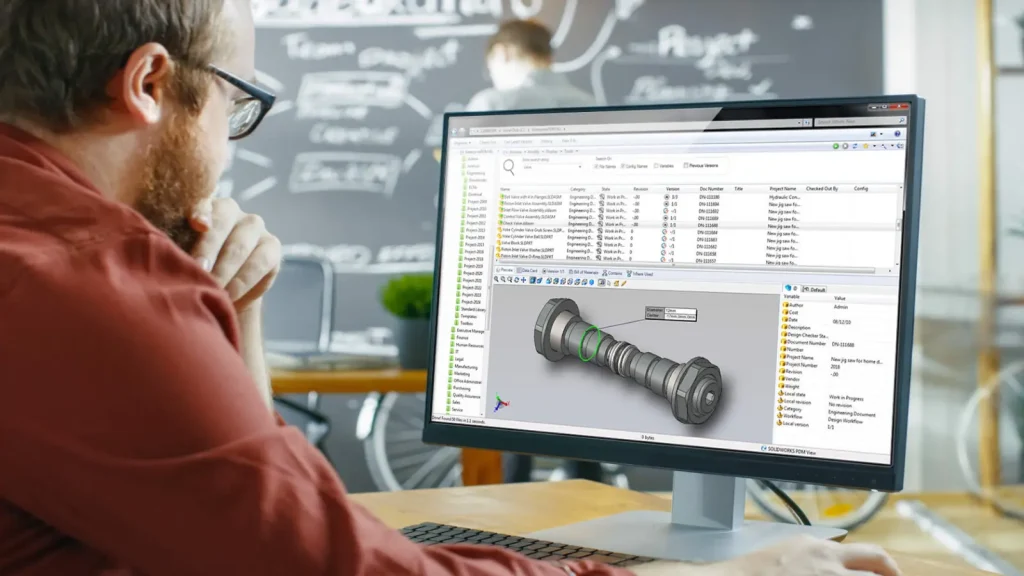
PDM primarily serves engineering departments, helping them manage complex product configurations and engineering changes. More specifically, PDM systems help engineering teams organize their product design files by providing a single source of truth, robust version control, change control, and a collaborative platform. Engineers don’t have to worry about working from wrong file versions or missing important updates and can focus on developing cutting-edge designs instead.
What is Product Lifecycle Management (PLM)?
Product Lifecycle Management (PLM) encompasses a broader range of activities that go beyond just managing product data. PLM is an integrated approach that spans the entire product lifecycle, from concept and design to manufacturing, distribution, and eventual disposal or retirement of the product.
Primary goal of PLM: To coordinate cross-functional teams, streamline processes, and optimize collaboration across the organization.
What kind of data do PLM systems manage?
PLM systems share a broader set of product data than a PDM system would. This includes product data such as requirements, bills of materials, project plans, problem reporting, manufacturing data, design approvals, packaging, marketing information, and more.

Who uses PLM?
PLM involves multiple departments in an organization as well as external teams, helping to reduce silos and improve communication.
- Manufacturing: PLM prevents handoff chaos. This ensures manufacturing teams always work from the latest approved designs, bills of materials, and process documentation.
- Procurement: PLM avoids costly change fallout. If engineering changes part of the design, the procurement team would be informed and be able to gauge the impact of the change on their work and carry out the change in the system (assess cost and supplier impact, and update sourcing decisions).
- Quality & Compliance: PLM becomes mandatory. Teams can get traceability, version history, and audit-ready documentation to support quality management, certifications, and regulatory compliance.
- Marketing / Sales Ops: Relevant when a company is at scale. Customer-facing teams can get consistent access to accurate product data (such as configurations, variants, and lifecycle status).
PLM is not project management
Project management tools track work execution, including tasks, owners, and deadlines.
PLM governs product decisions, including how product definitions change, who must approve those changes, and whether they are safe and compliant to release.
A project can be on time and still fail if a product change was approved incorrectly or released without considering downstream impact. PLM exists to prevent that class of failure.
Other key capabilities of PLM
- Ensuring compliance with industry regulations and standards, reducing risks, and ensuring product safety.
- Integrating with other enterprise systems to facilitate seamless data exchange and process synchronization.
- Forming the Digital Thread that connects data, business processes, and people assigned to those processes.
Learn more about benefits of PLM on our blog.
PDM vs PLM: A Comparison
PDM and PLM are closely related but serve two different purposes within product development and manufacturing. Let’s explore the differences between them:
Scope:
- PDM: Primarily focuses on managing and controlling data related to the design and engineering aspects of a product. This includes CAD files, documents, specifications, and other data used during the product design phase.
- PLM: Extends beyond product data to encompass the processes, collaboration, and decision-making throughout the product’s lifecycle.
Function:
- PDM: Mainly handles design and engineering data, ensuring version control, managing revisions, and enabling collaboration among designers and engineers.
- PLM: Goes beyond PDM by integrating various departments and stakeholders involved in different stages of the product lifecycle. It facilitates cross-functional collaboration, tracks changes, manages BOMs, handles regulatory compliance, and supports decision-making based on real-time data.
Lifecycle Focus:
- PDM: Primarily focuses on the early stages of the product lifecycle, emphasizing design and engineering data.
- PLM: Spanning the entire lifecycle of a product from initial concept and design through manufacturing, distribution, usage, and eventually disposal. It manages changes considering aspects like manufacturing, quality assurance, supply chain, service, and maintenance.
Collaboration:
- PDM: Enables collaboration within design and engineering teams, ensuring that the product design is accurate and consistent.
- PLM: Facilitates collaboration among cross-functional teams, including design, manufacturing, marketing, sales, and support, leading to better coordination and a more holistic approach to product development.

Decision Ownership:
- PDM: Engineering owns most decisions; others are informed.
- PLM: Decisions are shared across engineering, manufacturing, procurement, quality, and compliance.
Business Impact:
- PDM: Improves design and engineering efficiency, reduces errors, and ensures consistent data across the design phase.
- PLM: Provides a comprehensive platform for optimizing product development, reducing time-to-market, enhancing product quality, and improving overall business competitiveness.
How to Choose Between PDM and PLM
Choosing the right solution depends on an organization’s specific needs and the complexity of its products and operations. The key factor to consider is the scope and complexity of the product development process.
If your organization deals with more than just managing engineering data, such as handling ideation, design, collaboration, compliance, manufacturing processes, quality control, and post-sales support, then a PLM solution is more suitable as it encompasses the entire product lifecycle ensuring seamless integration and visibility for all stakeholders.
On the other hand, if your focus is primarily on managing engineering data, design documents, and CAD files without the need for broader cross-functional collaboration, a PDM system might be the right fit for your business.
Essentially, PDM is designed to help engineering teams manage CAD data and revisions. PLM becomes necessary when product data needs to flow across manufacturing, procurement, quality, and compliance.
When is PDM no longer enough?
In general, PDM stops being enough when product changes require evaluation and approval outside of engineering.
- When interactions happen outside of engineering: PDM focuses on CAD data and solves challenges experienced in the early product development lifecycle. Interactions with people outside of engineering can’t solely be done in a PDM tool. When organizations need to manage these interactions across teams and processes, this is where a PLM system comes to the fore.
- When engineering changes affect procurement: When procurement needs to assess the impact of an engineering change before acting on it, PDM is no longer sufficient. That impact may include questions such as whether the change increases unit cost, violates a negotiated supplier contract, or triggers the need for supplier requalification.
- When compliance audits increase: PDM is still sufficient when audits focus on engineering documentation, and the approval workflows are simple and local. But as auditors require cross-functional sign-off evidence, organizations must be able to demonstrate who approved a change, when it was approved, and under which rules or processes. When compliance audits require proof of process, not just proof of files, a company should move from PDM to PLM.
- When product variants explore: PDM is enough when product variants differ mainly in geometry or documentation. However, when product variants differ in constraints and impact, it’s time to consider PLM. For example, Variant A uses Supplier X, Variant B cannot; Variant C is allowed in Region X, Variant D is not; Variant E requires additional testing or certification.

FAQs
When is PDM enough?
PDM is usually sufficient when product data lives primarily in engineering, product variants are limited, and regulatory requirements are minimal. Another way to put it, PDM is enough when you just need vaulting, version control, and file sharing. Your work is local or single-site instead of global. Your BOM is simple (CAD BOM only), and you don’t need deep workflow automation beyond the basics of simple change management. Also, you don’t require regulatory traceability.
When should you use PLM instead of PDM?
You’re likely ready to move to PLM when product data must support broader business decisions. This typically happens when multiple teams depend on the same product data, engineering changes impact cost, supply, or compliance, or you’re managing products across regions or lifecycles – To put it another way, you should consider PLM instead of PDM when you have complex products with connected BOMs (EBOM, MBOM, MBSE), multi-discipline engineering (electrical, mechanical, systems, software, manufacturing engineers, etc.) – likely at the same time you need multi-site collaboration, change management, workflows, approvals, and project management. Other main use cases: when you need compliance and traceability, want to connect modelling and simulation, and have MBSE requirements and want to incorporate manufacturing.
Is PLM just PDM plus project management?
No. PLM goes beyond what PDM and project management tools can provide. Project management tracks execution of work (tasks, owners, deadlines), while PLM governs product decisions and their lifecycle impact across teams. PLM answers questions such as how product definitions change, who is required to approve those changes, and how those decisions affect downstream functions like manufacturing, procurement, quality, and compliance.
Can PDM replace PLM for small teams?
Yes, but only when product data is used primarily by engineering, changes have limited downstream impact, and compliance or variant complexity is low. As soon as product changes affect multiple teams (such as procurement, manufacturing, or quality) or require formal approvals and traceability, PDM is no longer sufficient. At that stage, PLM becomes necessary regardless of team size.

Choosing the Right Next Step
The choice between PLM and PDM hinges on the extent of your organization’s product development needs and the level of complexity involved throughout the lifecycle of your products.
Our team of experts are able to provide an agnostic evaluation, taking into account your business goals and requirements, to help you identify whether PDM or PLM would suit your business best.
With hands-on experience and access to both PDM and PLM solutions, the team approaches discovery without bias toward any specific platform. Instead, the focus is on identifying the correct solution for your business based on your current position and your future goals.


