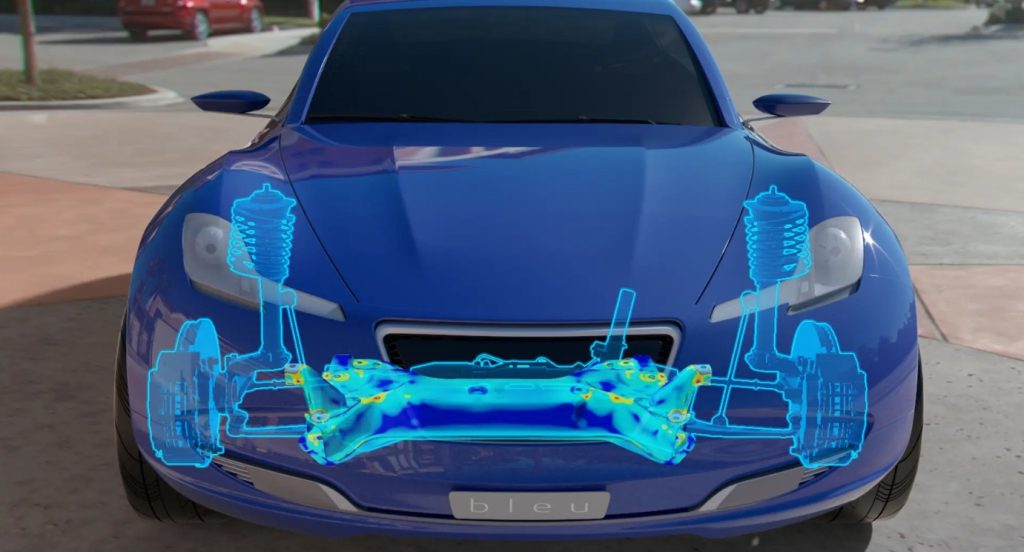










Simulation is no longer a specialist activity tucked away at the end of the design cycle, it’s at the very start of product development. With every new release, SIMULIA pushes the boundaries of what engineers can model, optimise, and validate, bringing high‑fidelity physics and intelligent automation into everyday workflows. This is the future of simulation.
The latest updates across the SIMULIA portfolio include faster insights, deeper physics, smarter automation, and more connected engineering teams. Whether you’re designing electric vehicles, medical devices, or next‑generation electronics, these innovations are reshaping how simulation drives decisions.
In this blog we take a look at the major themes that define SIMULIA’s newest capabilities.
Cloud Scalable Simulation
Engineering teams are under pressure to simulate more scenarios, more often, and with greater accuracy. SIMULIA’s expanded cloud and HPC integration removes the traditional bottlenecks of local hardware, enabling:
- Larger, more complex models
- Faster turnaround times
- Flexible, cost‑optimised compute
This shift makes enterprise‑grade simulation accessible to every engineer, not just those with dedicated HPC clusters.
Unified Modelling & Simulation on 3DEXPERIENCE
Disconnected CAD and CAE workflows are becoming a thing of the past. With software like SIMULIA tightening intergration on the £DEXPERIENCE platform allows engineers to bring modelling, simulation, data, and collaboration into one environment.
The result:
- Fewer handoffs
- Earlier validation
- Better traceability
- Faster design cycles
This is model‑based systems engineering in action and it’s becoming the new standard.
Real-Time Simulation in the Design Loop
One of the most transformative updates is real‑time feedback directly within your design tools. Engineers can now see performance implications instantly as they adjust any variables they may have.
This dramatically reduces the CAD to CAE to CAD loop and empowers teams to make informed decisions earlier than ever.
Next-Level Multiphysics
Modern products rarely involve a single physics domain. SIMULIA continues to strengthen its multiphysics capabilities, making it easier to capture interactions such as:
- Thermal–structural
- Fluid–structure
- Electromagnetic–thermal
These improvements are especially valuable in automotive, aerospace, electronics cooling, and energy systems where coupled behaviour defines real‑world performance.
Smarter Design Exploration with Isight & Tosca
Optimisation is now becoming the industry standard rather than it being used to compete. The latest enhancements in Isight and Tosca make it easier to:
- Automate complex workflows
- Run sensitivity studies
- Explore design spaces
- Achieve lightweighting and cost reduction goals
Engineers can now uncover better designs in less time, with less manual effort.
Python-Driven Automation
Python continues to take centre stage across the SIMULIA ecosystem. Expanded APIs and scripting hooks allow teams to:
- Automate repetitive tasks
- Build custom workflows
- Integrate simulation with enterprise systems
- Connect CAE with AI/ML pipelines
This is simulation as part of a broader digital thread, not a standalone activity.
Faster, More Robust Nonlinear Solvers
Abaqus remains the gold standard for nonlinear analysis, and recent releases have delivered major gains in:
- Contact stability
- Convergence behaviour
- Solver speed
- Large‑assembly robustness
These improvements translate directly into shorter solve times and more reliable results for the most challenging simulations.
Advances in Electromagnetics, Fatigue, and Materials
Across the portfolio, specialised tools continue to evolve:
- CST Studio Suite: Faster solvers, improved EMC/EMI workflows, and better antenna modelling
- fe‑safe: Stronger fatigue prediction for nonlinear materials and multi‑axial loading
- Opera: Enhanced low‑frequency EM capabilities for motors, actuators, and sensors
- PowerFLOW & XFlow: High‑fidelity CFD for aerodynamics and thermal management
- Expanded material models: More accurate representation of composites, foams, plastics, and biological tissues
These updates help engineers simulate the real world with greater confidence.
Learning Built Into the Platform
As simulation becomes more powerful, SIMULIA is making it easier for new users to get up to speed. Embedded learning paths and role‑based training inside 3DEXPERIENCE help teams adopt new tools faster and more effectively.
Want to See the Abaqus Enhancements in Action?
As the future of simulation moves earlier in the design process and becomes more integrated and automated, it’s easy to miss just how quickly Abaqus is evolving to support that shift.
Every year, Abaqus introduces dozens of improvements but most engineers don’t have time to sift through release notes.
That’s why we’re hosting a short, focused webinar covering the most valuable Abaqus enhancements from 2024 through to the latest 2026 release.
You’ll see highlights across:
- New physics
- Solver performance
- Contact and nonlinear improvements
- CAE workflow upgrades
If you want a clear, practical rundown of what’s new and what’s worth adopting this on-demand session is for you.