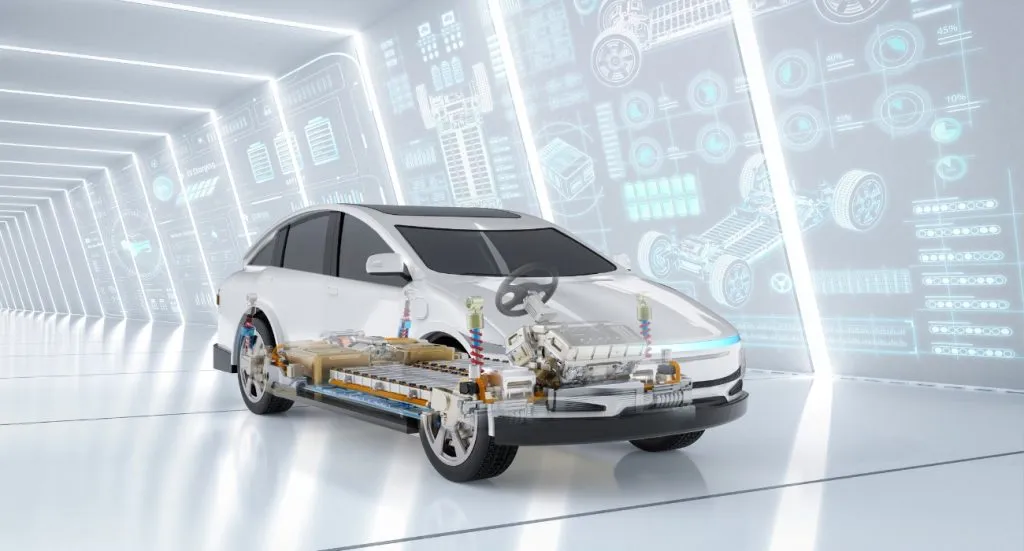






As electric vehicles (EVs), renewable energy storage, and mobile electronics surge forward, battery engineering is undergoing a quiet revolution. It’s no longer just about chemistry and packaging, it’s about speed, intelligence, and precision.
To keep up with rapidly evolving performance demands and ever-tighter timelines, the industry is shifting toward a new paradigm: AI-assisted, automated, and simulation-first battery design. It’s a future where physical prototypes take a back seat, and intelligent digital twins drive innovation from concept to production.
So what exactly does this future look like and how can your organization stay ahead of the curve?
Simulation-First Design Is Becoming the New Standard
Historically, battery development has been a cycle of physical testing, trial-and-error, and iterative redesign. But that process is slow, expensive, and limited in scope.
With the rise of high-fidelity multiphysics simulation tools like SIMULIA, engineers can now digitally model and optimize battery performance from electrochemical behavior to mechanical stress, from thermal management to degradation, before building a single prototype.
Benefits of simulation-first design include:
-
Accelerated time-to-market
-
Reduced physical testing costs
-
Safer, more robust designs
-
The ability to explore thousands of design variables virtually
The SIMULIA Battery Design Solution, combined with the 3DEXPERIENCE platform, allows you to simulate every aspect of the battery lifecycle, from individual cell chemistry to full pack integration, under realistic operating conditions.
AI & Machine Learning: From Guesswork to Guidance
AI is transforming battery design from reactive to predictive. By training machine learning (ML) models on historical test data and simulation results, engineering teams can identify optimal configurations, predict failure points, and explore new chemistries far faster than traditional methods allow.
Imagine being able to:
-
Predict thermal runaway conditions without full-scale testing
-
Discover material combinations that maximize energy density
-
Automatically generate design variants that meet your constraints
Tools powered by AI and machine learning algorithms, when integrated with simulation workflows, turn massive data sets into actionable insights. The 3DEXPERIENCE platform makes this possible by unifying data, models, and analytics in a single collaborative environment.
Automation Enables Scale Without Compromise
Manual simulation processes are time-consuming and prone to error. As the pace of innovation accelerates, automation is no longer optional, it’s essential.
Automated workflows allow engineers to:
-
Run batch simulations across multiple design variants
-
Execute optimization studies across multi-objective parameters
-
Standardize validation and reporting processes
With SIMULIA, you can build fully automated simulation pipelines that streamline every stage of battery engineering from material calibration to virtual validation freeing up teams to focus on design insight, not repetitive tasks.
Automation also enables true Design of Experiments (DoE) and optimization under uncertainty, which are critical for meeting performance targets in a complex, multi-constraint design space.
Collaboration Through the 3DEXPERIENCE Platform
To truly realize the benefits of AI, automation, and simulation-first design, teams need to work within an integrated, cloud-based environment.
The 3DEXPERIENCE platform connects simulation, design, manufacturing, and data management in a single digital thread. This enables:
-
Seamless collaboration across disciplines
-
Real-time access to the latest simulation data
-
Faster decision-making and reduced risk of misalignment
Battery engineering is no longer the responsibility of isolated teams it’s a cross-functional effort that spans design, thermal analysis, materials science, and manufacturing. The 3DEXPERIENCE platform ensures everyone is working from the same source of truth.
The Future Is Already Here, Are You Ready?
The next generation of battery innovation will be defined not just by chemistry, but by intelligence, speed, and systems thinking. AI, automation, and simulation-first design aren’t just trends, they are becoming core competencies for competitive battery programs.
By adopting the SIMULIA suite and integrating your processes with the 3DEXPERIENCE platform, your team can move faster, design smarter, and stay ahead in a rapidly evolving market.
Want to see how AI-driven simulation can future-proof your battery development? Let’s start a conversation.