







Interview with Rajkaran Singh from Dassault Systèmes about Aerospace Decarbonisation
Apr 18, 2024
It is no secret that every sector and industry across the globe is thinking about decarbonisation and how they can utilize it to achieve their sustainability targets. But what does decarbonisation really mean?
We were able to speak with Dassault Systèmes Director Rajkaran Singh regarding the subject. We took the opportunity to ask him what decarbonisation really means, and what it signifies. We were also able to get his thoughts on what role virtual twins and digitization are likely to play going forward.
Why is Aerospace decarbonisation is so important?
When thinking about the importance of decarbonisation, Rajkaran highlighted that the Aerospace Industry is on the verge of a major disruption, like none we have seen since humans first took flight. With new concepts emerging with the ideal to tackle sustainable aviation, revolutionary practices are set to take hold.
Sustainable aviation and decarbonisation in aviation is not a matter of if, anymore, it’s a matter of how and when.
With 2050 targets and the Paris Agreement in mind, Rajkaran told us that the industry is rallying together to come up with some of the most innovative solutions and concepts to achieve their targets for sustainable aviation. He highlighted that the only way to achieve these targets will be through disruption and rapid innovation.
Rajkaran told us that at Dassault Systèmes, they feel digitization will be one of the main enablers in ensuring the industry is able to meet these targets.
What is driving the race to decarbonisation?
With countless structural and systemic changes taking place in the aerospace sector during and following the global pandemic, Rajkaran explained to us that every CEO in the aerospace sector will now have decarbonisation on their agenda.
Going forward, a clear challenge of the ecosystem around sustainable aviation has become apparent. Not only affecting aircraft design, sustainable fueling or infrastructure individually, an end-to-end ecosystem designed to support sustainable aviation and therefore decarbonisation is essential.
How do digitisation and virtualism support decarbonisation of aircraft?
It is clear that in order to promote sustainable aviation, the problem of how best to decarbonise is paramount. When thinking about this challenge, Rajkaran was clear that the in view of Dassault Systèmes, the way to do this is through digitisation.
It is an ecosystems problem. It’s a systems of systems problem, which the industry needs to come together to solve.
Rajkaran highlighted that there really is no easy answer. There is no single technology which will enable the industry to meet the goal of decarbonisation. Instead, there are multiple roadmaps and levers which will help to enable the innovation required.
Whilst there is no ‘silver bullet’, Rajkaran did emphasise that there are four key areas in which this innovation can be drawn from. These include:
- Technology and infrastructure improvements
- Developing and accessing new sustainable aviation fuels
- Electric and hydrogen aircraft
- Market based measures
Rajkaran explained that the common denominator to all these potential roadmaps is that the technology of virtual twins, technologies that can facilitate collaboration across different parts of the industry, and looking at the entire end-to-end lifecycle of the complex systems and products involved is going to be the key in achieving decarbonisation.
What key trends do you expect to see throughout the Aerospace Industry?
Rajkaran told us that there are some very exciting trends coming up in the industry. With huge disruptions and creative innovation, the aircraft of the future are going to look very different to what we see in the skies today.
“The new propulsion concepts, be it electric, hybrid or hydrogen, are going to change the face of aviation as we know it.”
Since Frank Frankfurters original jet engine, we have come a long way. Rajkaran explained that there are even more exciting changes coming our way. This will include concepts we are familiar with hearing about (including blended wing body concepts and transonic thrust based wings), but in the coming years we are looking at the biggest shift aviation technology since that original jet engine.
Rajkaran highlighted that these coming changes are going to be geared towards sustainable aviation concepts and decarbonisation alike.
Categories
Related Content
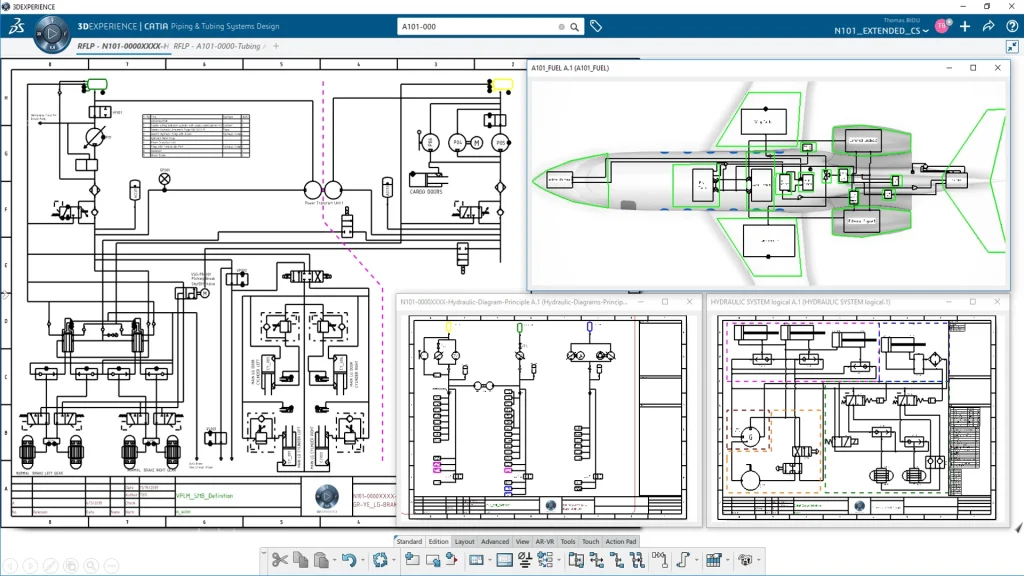
Systems Schematic Engineer
Create discipline-specific intelligent schematics for wiring, cabling, piping/tubing and HVAC systems with the CATIA Systems Schematic Engineer

5 Key Must-Haves for Success in the Advanced Air Mobility (AAM) Industry
The advanced air mobility (AAM) industry, which encompasses technologies like electric vertical take-off and landing (eVTOL) aircraft, autonomous flying vehicles, and air taxis, is rapidly evolving. While innovation and progress are at the heart of AAM, achieving success in this competitive and complex space requires more than just groundbreaking ideas. In this article we will…
The Importance of Aircraft Certification
Aircraft certification is a critical step in ensuring the safety, reliability, and performance of an aircraft. It is a rigorous process that guarantees an aircraft meets the necessary standards set by regulatory bodies, such as the Federal Aviation Administration (FAA) in the United States or the European Union Aviation Safety Agency (EASA) in Europe. Certification…