











Computational Fluid Dynamics (CFD) is a powerful simulation tool that plays a pivotal role in various industries by analyzing fluid flows and their interactions with surfaces and structures. By leveraging numerical methods and algorithms, CFD enables engineers and scientists to simulate fluid behavior, offering insights that would be difficult or impossible to achieve through experimental methods alone.
With the help of SIMULIA’s Computational Fluid Dynamics (CFD) simulations, clients may rapidly develop products with accurate real-world performance forecasts.
In this blog we will cover the various uses and benefits of Computational Fluid Dynamics.
What is Computational Fluid Dynamics?
CFD involves the use of computational methods to solve the equations governing fluid motion. These equations describe how fluids behave under various conditions, encompassing aspects such as velocity, pressure, density, and temperature.
Key Uses of Computational Fluid Dynamics
The uses of CFD are vast and impactful. Used in various industries, CFD can be applied in many different ways to assist with a variety of design problems.
Below are a few examples of the various industries in which CFD can have an impact.
Aerospace: In aerospace, CFD is essential for analyzing airflow around aircraft, which is crucial for optimizing aerodynamic performance. Engineers use CFD to study drag reduction, lift enhancement, and overall stability, ultimately leading to more fuel-efficient and safer aircraft designs.
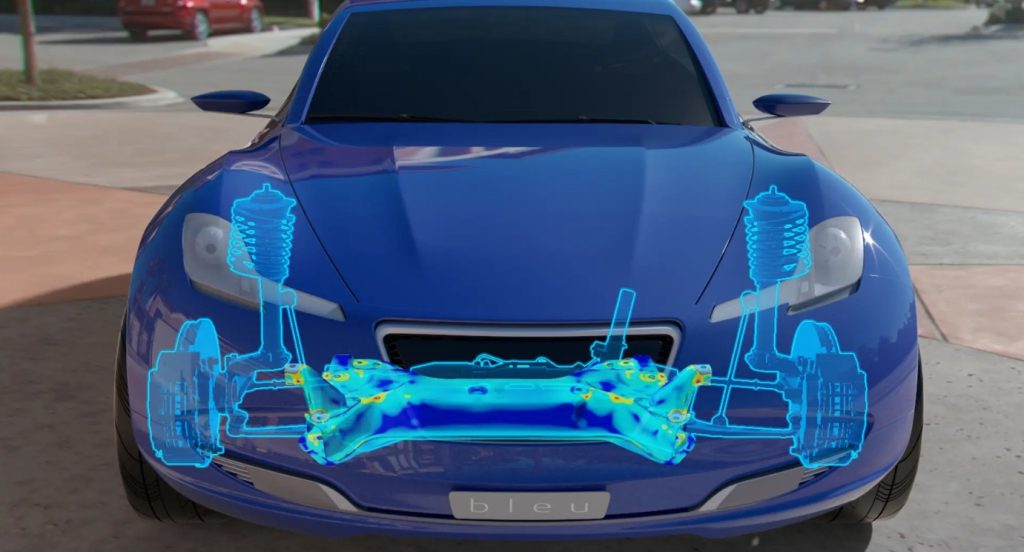
Automotive: CFD simulations are used extensively in automotive design to improve vehicle aerodynamics, cooling systems, and internal airflow. By simulating airflow over vehicle bodies, manufacturers can identify areas that create drag, allowing for design adjustments that enhance performance and fuel efficiency.
Civil Engineering: In civil engineering, CFD is applied to study wind loads on buildings, bridge designs, and environmental impacts of structures. This helps in ensuring the safety and stability of structures in various weather conditions.
Chemical Engineering: CFD plays a vital role in the design and optimization of chemical processes. It helps in understanding mixing processes, reaction kinetics, and heat transfer in reactors, which can lead to improved efficiency and reduced costs in chemical production.
Biomedical Applications: In the biomedical field, CFD is used to model blood flow in arteries and veins, aiding in the design of medical devices such as stents and prosthetic heart valves. Understanding fluid dynamics in biological systems can lead to better treatment options and improved patient outcomes.
Energy Sector: CFD is crucial in the energy sector for optimizing the design of wind turbines, analyzing airflow in gas turbines, and studying heat exchangers. It enables engineers to enhance efficiency and performance in various energy generation methods.
Benefits of Computational Fluid Dynamics
Quicker turnaround times: Because simulation speeds up analysis and optimization, design cycles can be shortened, and a competitive edge can be gained.
Less dependence on testing: Simulation is quicker, less expensive, and can be used earlier in the design cycle than wind tunnel testing. Additionally, CFD can also disclose behavior that a test cannot see.
High-performance, adaptable simulation technology: With CFD it is possible to simulate aerodynamics and aeroacoustics on large and complicated structures, and under real-world circumstances.
Reduced work with automation: Engineers can obtain the data they require more quickly because of automated meshing, model-building, visualization, and Design of Experiments (DoE), which eliminates time-consuming setup work.
Leveraging design models: Unified modelling and simulation (MODSIM) reduces the amount of time required for model creation by enabling simulation to be done immediately on geometry from CATIA or SOLIDWORKS in a unified design environment.
Complete analysis using simulation from Multiphysics: Additional disciplines, including vibro-acoustic, structural, electromagnetic, and multibody system simulation, can be used to enhance fluids simulation.
SIMULIA Computational Fluid Dynamics Sub Disciplines
Aeroacoustics Simulation
One of the most common grievances from drivers and passengers in the automotive sector is noise. A lot of work goes into reducing noise from all sources.
The airflow around structures and the noise they make can be modelled using CFD. Early in the design process, any noise issues can be found and fixed, saving both time and money. Many real-world situations can be taken into account, including ones that are difficult to test on a test track or in a wind tunnel.
A variety of strong fluid simulation tools are available from SIMULIA that may address a variety of aeroacoustics issues and difficulties, such as:
- Wind noise from the car’s greenhouse and underbody
- Buffeting of the sunroof and windows
- Noise from the community and passing cars
- Noise from wind turbines
- HVAC and cooling fan noise
- Noise from propulsion
Aerodynamics Simulation
From the very beginning of development, aerodynamics design is influenced by both major structures and minute elements that evolve during the process. By incorporating simulation into design, engineers may minimize possible problems and maximize product performance without having to pay for wind tunnel testing.
SIMULIA offers a number of powerful fluid simulation tools that can be used to solve a range of aerodynamic problems and situations, such as:
- Drag reduction and aerodynamic efficiency
- Flight dynamics and high lift systems
- Management of vehicles
- Mud, rain, and snow control in soiling
- Deformation of the panel
- The wind load
Conclusion
Computational Fluid Dynamics has revolutionized the way engineers and scientists approach fluid behavior analysis. Its applications span multiple industries, offering significant benefits such as cost savings, enhanced accuracy, and rapid design iteration. As computational power continues to grow, the role of CFD in innovation and efficiency will only expand, paving the way for advancements in technology, safety, and sustainability across various fields.